History & Future of U.S. Shipbuilding
History & The
Inflection Point
The United States built 60–70% of the world’s ships in 1945. It builds less than 1% today. That collapse did not happen overnight — and it will not be reversed with the same tools that produced it.
YOU DON’T REBUILD WITH 100-YEAR-OLD TECHNOLOGY
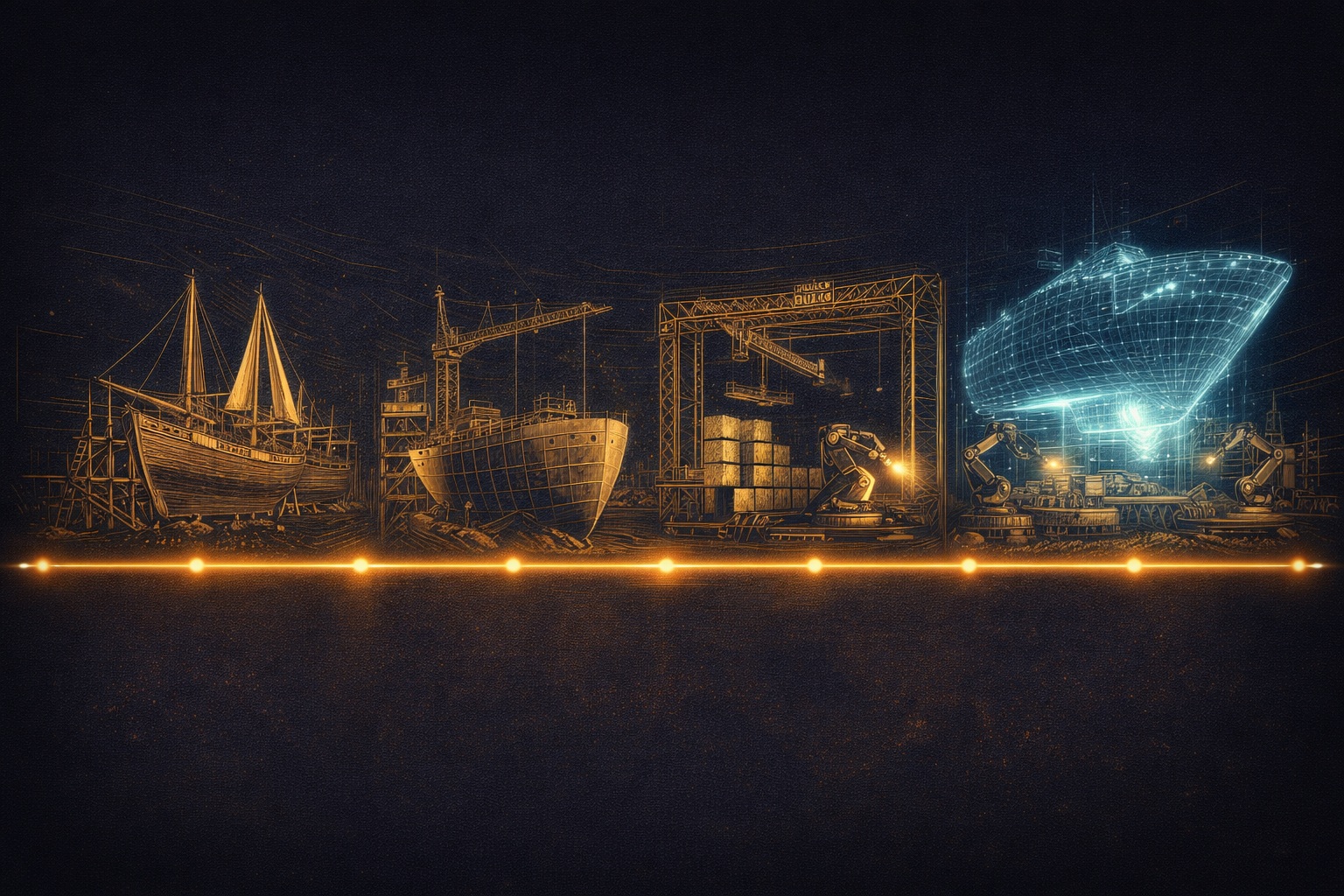
Leading Asian yards achieve 75–80% fewer labor hours per compensated gross ton versus U.S. legacy yards. The difference is the production system itself — not the workers.
America at Gen 2.5. Asia moved to Gen 3 in the 1970s, then automated through it to Gen 3+ by the mid-2000s. Asia at Gen 4(minus) today — iterative improvements by dominant global commercial shipbuilders. The U.S. sat out both transitions.
After the wartime peak, the U.S. shipbuilding industry entered a long contraction: too many yards fighting over too little work. The rational economic response was not innovation — it was consolidation. Yards acquired competitors to capture their order books and eliminate competition, consolidating the best available equipment from multiple aging facilities into fewer operating sites.
The economics never justified building new. It was always cheaper to acquire an existing yard and continue operating with proven — if inefficient — methods than to spend billions rebuilding from scratch for an incremental improvement in margin. Life-extending old infrastructure and using established labor models to sustain production was the rational choice for any individual enterprise. No single yard could justify the capital required to leap to a new production generation when the existing model still functioned.
Asia did not face this constraint. Japanese and Korean shipbuilding infrastructure was decimated after World War II. They had to rebuild from nothing — and when they did, they built incrementally into Gen 3 block construction and then drove heavy automation through it to Gen 3+. That greenfield start gave them a compounding structural advantage that U.S. yards, locked into their existing economics, could not convert to chase. The result was a steady, irreversible transfer of global market share from the United States to Asia over three decades.
HOW AMERICA FELL TWO GENERATIONS BEHIND
| Period | Event | U.S. Position |
|---|---|---|
| ~1850 | Peak wooden ship era. Abundant old-growth timber gives U.S. yards a decisive cost advantage. American yards dominate merchant shipping. | 30–35% of global oceangoing merchant tonnage. |
| 1860s–1880s | Europe transitions to metal. Deforestation forces European yards to adopt iron and steel hulls. U.S. stays with wood — cheap timber and sunk investment in wood-specific infrastructure make conversion economically irrational. | Share declining. Structural lock-in deepening. |
| 1886 | First structural collapse visible. Metal hull vessels dominate global trade. U.S. yards, still optimized for wood, lose competitive position rapidly. | ~14–15% of global tonnage. |
| 1914 | Dependency exposed. European fleets withdraw into national service. U.S. exports accumulate on docks. The Emergency Fleet Corporation launches — produces 1,000+ ships, but too late to affect the early war. The cost of decades of underinvestment becomes visible overnight. | ~5% of global merchant share. Structurally dependent on foreign carriers. |
| 1920 | Structural response. Congress passes the Jones Act, mandating U.S.-built, U.S.-owned, U.S.-crewed vessels for domestic trade. An industrial base is restored by policy design, not market forces. | Rebuilding. Domestic base secured. |
| 1945 | Wartime peak. Liberty ships and T2 tankers produced at unprecedented scale. The largest industrial mobilization in history. Capacity is massive — but built for one era. | 60–70% of global shipbuilding output. |
| 1950s–1980s | Contraction and consolidation. Massive wartime surplus suppresses new-build demand. Too many yards compete for too little work. The rational response is acquisition and consolidation — not reinvention. Yards acquire competitors, eliminate capacity, and life-extend aging infrastructure. | Declining. ~5% by 1975. |
| 1970s–1990s | Asia leaps to Gen 3. Japan and Korea, rebuilding from wartime destruction, build greenfield block construction yards from scratch. Purpose-designed, dramatically more efficient. U.S. yards — locked into consolidation economics — cannot justify the investment to follow. | Below 5% and falling. |
| 1995–2005 | Asia automates to Gen 3+. Automotive-industry automation enters Asian shipbuilding. CNC cutting, robotic welding, automated panel lines drive heavy automation into block construction. The compounding advantage from Asia’s greenfield start accelerates the gap further. | U.S. cannot follow. Gap becomes multigenerational. |
| Today | America at Gen 2.5. Asia at Gen 4(minus) — iterative improvements by dominant global commercial shipbuilders. Legacy U.S. yards still build piece by piece. 4–5 oceangoing commercial hulls per year against demand for 25–30. | < 1% of global commercial shipbuilding. |
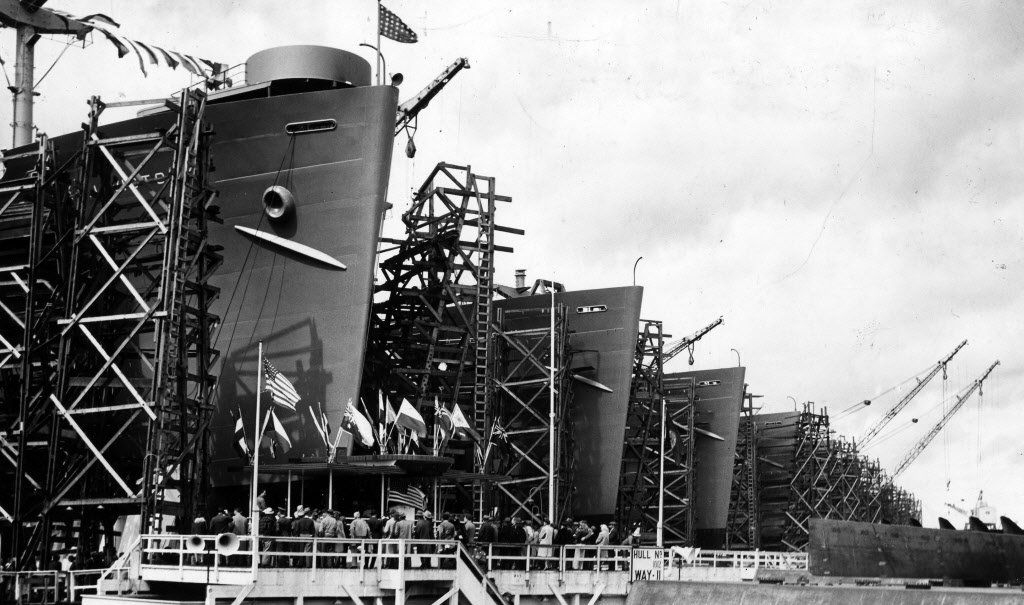 Oregon Shipbuilding Corporation, Portland, 1944 — NARA / Public Domain
Global shipbuilding dominance has shifted three times in the past two centuries — each time driven by a new production technology that the incumbent could not adopt within its existing economics. Wooden yards could not convert to metal. Craft-based metal yards could not convert to block construction. In each case, the transition required a greenfield start. The incumbent held market share through inertia until the new entrant reached sufficient scale — then the transition was rapid and essentially irreversible.
Asia made those transitions — block construction and then heavy industrial automation to Gen 3+ — by building new from wartime rubble. That compounding greenfield advantage is what moved global dominance eastward, and the yards that executed it are the best commercial shipbuilders in the world today, operating at Gen 4(minus) with ongoing investment in Gen 4 elements. But those yards are now 15–25 years into their operating lives, and they face a similar structural trap of sunk cost in Gen 3+ infrastructure that does not permit wholesale transformation to a full end-to-end Gen 4 platform. Instead, the economics restrict them to continuous incremental improvements against the installed architecture. Massive reinvestment would be required to keep pace with a clean-sheet Gen 4+ deployment.
There is a second dimension. Every major shipbuilding nation in Asia — Japan, South Korea, China — sits within mutual hypersonic missile range. In any major conflict, those production bases face existential risk simultaneously. That leaves the United States and Europe as the surviving industrial base — and the United States, embarking on a Gen 4+ greenfield transformation, as the nation best positioned to build the next generation of capacity from first principles. The established primes in the domestic market face the same structural constraints that have prevented conversion in every prior era.
WHY THIS MOMENT RHYMES
History shows that global shipbuilding dominance shifts when production systems become structurally obsolete — not when demand weakens. Each reversal followed the same pattern: legacy yards endured under constraint, new production models emerged, and dominance moved once those models proved scalable. The United States now sits at a comparable inflection point. The conditions that define every prior reversal — entrenched legacy systems approaching obsolescence, external pressures exposing vulnerability, and a new production paradigm available to deploy — are present simultaneously for the first time in eighty years.
U.S. shipyards operate on production methods 50–100 years old. Conversion is structurally impossible — the same trap that caught wooden yards facing metal, and craft yards facing block construction.
The strategic reality that drove the Emergency Fleet Corporation in 1917 and the Liberty Ship program in 1941 is reasserting itself. A nation that cannot build ships cannot control its own security or commerce.
Fourth-generation shipbuilding is not experimental. It has been operating at scale in Asia for 15–20 years. The methodology is proven. The hardware is current. The path is clear.
Every prior reversal in shipbuilding dominance produced a long structural upcycle — 50 to 100 years. The nation that builds the next production system secures generational advantage.
Bipartisan alignment on domestic shipbuilding has reached a level not seen since the postwar era. The recognition that America’s shipbuilding deficit is an existential challenge — spanning economic security, national defense, and supply chain resilience — now runs across the political spectrum. Executive orders have designated domestic shipyard development a federal priority. The FY2026 Navy shipbuilding budget and NDAA authorizations represent the strongest sustained federal commitment to the sector in decades. Multiple legislative proposals addressing shipbuilding capacity are advancing simultaneously.
The policy environment is not waiting for any single piece of legislation. The structural demand for domestic shipbuilding capacity already exceeds what any individual act contemplates. Federal agencies have been directed to prioritize permitting for projects that advance domestic shipbuilding. Private capital is flowing into the sector at a scale not seen in generations. The policy foundation is broad, bipartisan, and structural — not dependent on the passage of any one bill or the priorities of any single administration.
History shows that shipbuilding dominance shifts when production systems become structurally obsolete. Legacy yards endure under constraint. New production models emerge. Dominance moves once those models prove scalable. The pattern has repeated three times in two centuries, and each time the transition was irreversible.
The question facing the United States is no longer whether shipbuilding will move to high automation in America, but how. Legacy yards cannot provide the answer. Their site geometry is fixed, with urban areas built up around them over decades — there is no room to reconfigure material flow for a modern production system. Their labor pools are organized around craft-based methods and deeply resistant to automation that would reduce headcount. Their capital structures do not permit raising the billions required for wholesale transformation, nor can they shut down operating capacity to rebuild it. These are not obstacles to be overcome with better management. They are the same binding structural constraints that prevented wooden yards from converting to metal, and craft yards from converting to block construction. The path forward is the same path history has required every time: build new, without legacy constraints, with the current generation of technology. That is the only way this transition has ever worked.